In the world of corporate innovation, terminology is everywhere, and clarity is rare.
Executives talk about open innovation. Innovation managers mention corporate venturing. Finance teams discuss corporate venture capital. Meanwhile, event organisers promote innovation challenges, consultants sell startup programs, and strategy departments debate venture clienting.
The problem is not that these concepts are often used interchangeably, even though they describe different layers of the same system. Laurent Kinet, Novable’s co-founder and CEO, explains where this problem comes from:
Over the years, through my work at Novable, I have had the opportunity to speak with hundreds of innovation professionals from large organisations: heads of innovation, corporate venture leaders, strategy executives, and R&D managers across industries. One thing strikes me again and again. Even among experienced practitioners, there is a surprising amount of confusion about the terminology itself.
People use the same words to describe different practices, or different words to describe the same ones. As a result, discussions about innovation strategies sometimes become unnecessarily complicated, simply because the vocabulary is unclear.
This article is an attempt to clarify these terms.
At Novable, we operate at the intersection of corporate innovation and startup ecosystems, helping organisations identify and engage with emerging technologies and startups worldwide. These conversations constantly reveal how useful it would be if the innovation community shared a clearer conceptual map of the field.
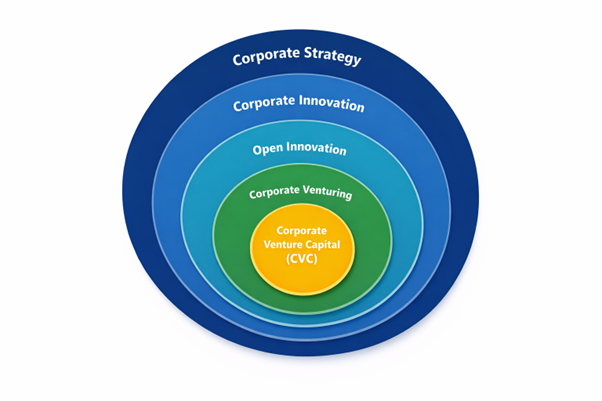
A helpful way to understand the landscape is to think in concentric circles, starting from the broadest concept and moving toward the most specific.
At the centre lies corporate venture capital. Around it sits corporate venturing. Around that, open innovation. And all of it ultimately belongs to the broader discipline of corporate innovation, itself part of corporate strategy.
At the highest level sits corporate strategy. Strategy answers the fundamental questions that define the future of the organisation:
Innovation is not a separate activity from strategy. It is one of the main tools through which strategy is executed. When a company decides it must explore new technologies, enter adjacent markets, or reinvent its business model, innovation becomes a strategic necessity. Without this strategic direction, innovation initiatives often degenerate into isolated experiments, disconnected from the company’s long-term priorities.
Innovation without strategy is just experimentation.
The next layer is corporate innovation. Corporate innovation encompasses all the activities an organisation deploys to renew itself and remain competitive over time.
These activities can take many forms, including:
Some innovation happens inside the organisation. Some happen with external partners. Increasingly, successful innovation strategies combine both. Large organisations have realised that they cannot rely solely on internal resources to innovate. Technologies evolve too quickly, and startups often move faster than corporate R&D departments.
This realisation gave rise to a concept that became central in the early 2000s: open innovation.
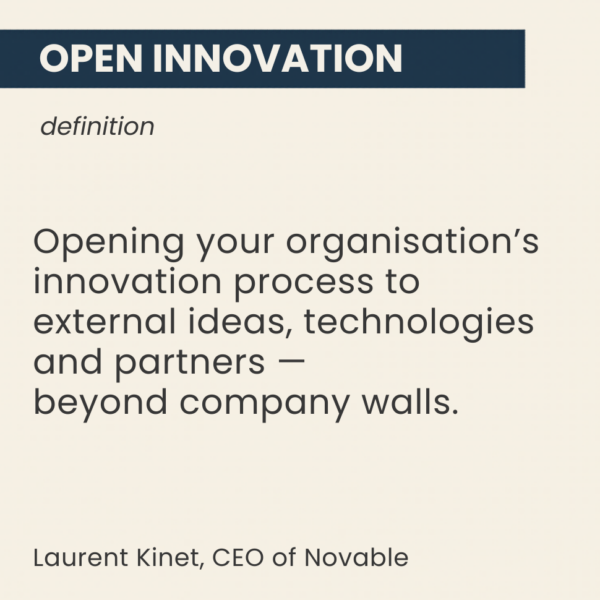
The term open innovation was popularised by Henry Chesbrough in his influential book Open Innovation: The New Imperative for Creating and Profiting from Technology.
The idea is simple but powerful. Instead of relying exclusively on internal research and development, organisations should open their innovation processes to external ideas, technologies and partners.
In practice, open innovation can involve collaboration with many types of external actors:
Open innovation is therefore not limited to startups. It is a broader philosophy that recognises that valuable knowledge exists outside the organisation. Companies may license technologies, collaborate with universities, crowdsource ideas, run innovation platforms, or build ecosystems around their products.
Among the many forms open innovation can take, one has gained particular prominence over the past decade: corporate venturing.
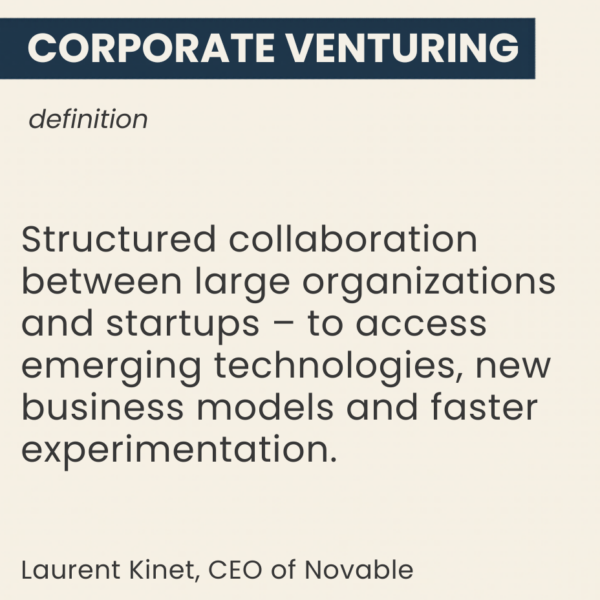
Corporate venturing refers to the structured collaboration between large organisations and startups. Startups play a crucial role in innovation ecosystems because they often explore emerging technologies, business models and market niches much faster than established companies.
For corporates, working with startups offers several advantages:
Corporate venturing has therefore become one of the most dynamic areas of corporate innovation. However, corporate–startup collaboration can take many different forms. In his book Corporate Venturing, a Framework, Laurent describes a range of models through which organisations can engage with startups strategically.
These include for example:
Each model serves different strategic purposes. Some focus on experimentation, others on technology access, and others on long-term transformation.
Among these models, one sits at the most specialised end of the spectrum: corporate venture capital.
Corporate venture capital (CVC) refers to the practice of corporations investing in startups through equity stakes, typically via a dedicated investment arm.
Well-known examples include:
Unlike traditional venture capital funds, corporate venture capital units often pursue both financial and strategic objectives.
Their goals may include:
CVC has grown significantly in recent years, with many large companies launching dedicated investment funds. However, it is important to understand that investment is only one form of startup collaboration. Many corporate–startup relationships begin with partnerships, pilots or venture clienting models before any investment is considered.
In other words, corporate venture capital is a subset of corporate venturing, not the other way around.
Another source of confusion comes from innovation formats, which are often mistaken for innovation strategies.
For example, many organisations organise:
These initiatives are useful, but they are primarily tools for sourcing and interacting with startups, not strategic frameworks in themselves. An innovation challenge may help identify promising startups. An accelerator may help explore technologies. A hackathon may generate ideas. But in fine, what will the company actually do with the startups it discovers?
This is where structured corporate venturing approaches become essential.
At first glance, these distinctions may seem academic. In reality, they matter greatly. When organisations confuse open innovation, corporate venturing and corporate venture capital, several problems arise:
Clarity of language helps organisations design coherent innovation systems, aligning strategy, tools and execution.
Even once terminology is clarified, another challenge remains. The global startup ecosystem is vast and fragmented. Thousands of startups emerge every year across technologies, markets and geographies.
Innovation teams often struggle to answer fundamental questions:
This is where specialised innovation intelligence platforms have emerged.
Solutions such as Novable help innovation teams identify, validate and engage with the most relevant startups worldwide, combining technology-driven sourcing with expert validation to support corporate innovation and venturing initiatives.
Beyond scouting, organisations often need deeper analysis, workshops, or structured engagement with startup ecosystems. This is where services such as Novable Advisory complement the platform by providing tailored reports, startup interactions and strategic workshops designed to support innovation initiatives and corporate venturing strategies.

Understanding the vocabulary of corporate innovation goes beyond the semantic exercise. It helps organisations see innovation for what it really is: a layered system connecting strategy, ecosystems and execution.
At the highest level, corporate strategy defines the direction. Corporate innovation ensures renewal. Open innovation connects the organisation with external ecosystems. Corporate venturing structures collaboration with startups. And corporate venture capital provides one possible investment mechanism within that framework.
Once these layers are clearly understood, companies can design innovation strategies that are not only ambitious, but also operational. And in a world where technological change is accelerating, that clarity may well become a decisive competitive advantage.
Laurent Kinet
CEO Novable