Innovation rarely breaks because of a lack of ideas. More often, it breaks somewhere between teams.
Between the people building and the people selling, product managers and engineers. Between startups moving at speed and corporations moving through layers of approvals, metrics, and competing priorities.
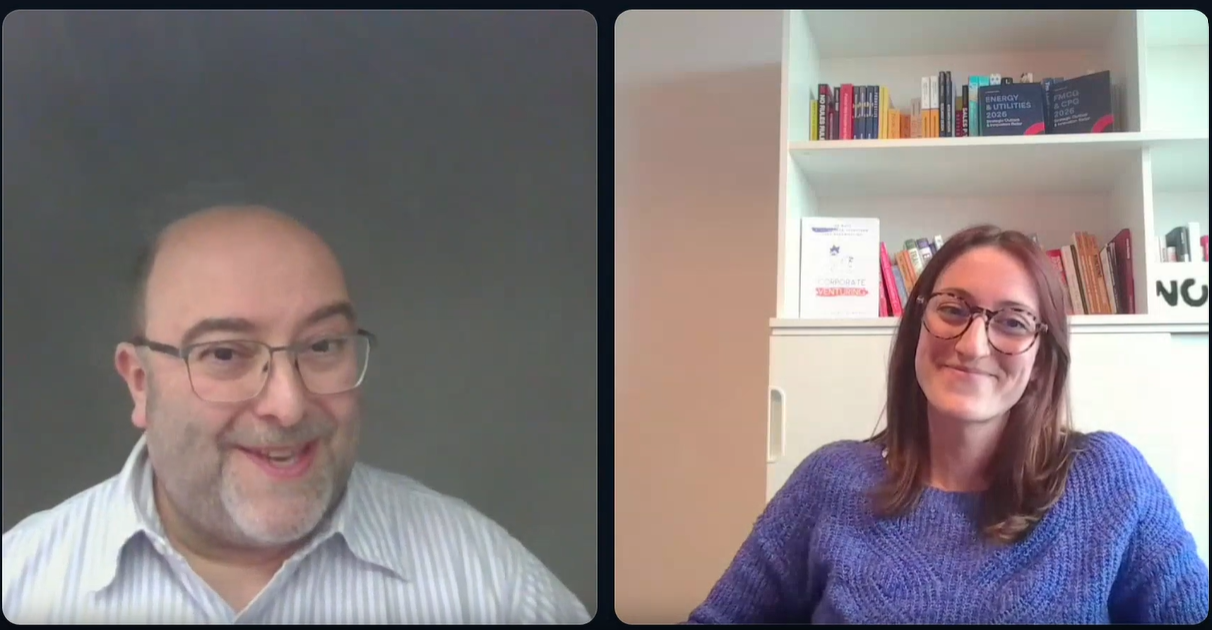
That was the core theme of Novable’s recent live conversation, Where Innovation Breaks, an unscripted 30-minute session featuring Dr. Dominic Mikulin, Technology & Business Incubation Architect at Fujitsu.
Hosted by Novable’s Client Success Manager Irene Violleta and introduced by CEO and co-founder Laurent Kinet, the conversation focused on a challenge many innovation leaders know well but rarely discuss openly: innovation failure is often less about technology and more about human understanding.
And according to Dr. Dominic Mikulin, that breakdown usually starts with one thing: silos.
Watch the full recording below
Dominic’s career has placed him between worlds for decades – from PhD research in liquid crystal displays (where physicists, chemists, and material scientists had to actually collaborate) to deep-tech startups, innovation consulting, and his current role at Fujitsu. His clearest observation, accumulated over all of it:
“No matter how hard the technology is that we try and do, people problems are always harder than technology problems.”
Each specialism develops its own vocabulary, KPIs, incentives, and constraints. Specialization increases efficiency within teams – but it also creates barriers between them. When understanding disappears, collaboration usually follows.
What this means for you: If an innovation initiative feels stuck, resist the instinct to diagnose it as a technology or methodology problem first. Ask instead ‘do the people involved actually understand what the other side is trying to achieve, and what’s getting in their way?‘
Laurent Kinet opened the session with an observation Novable encounters regularly where scouting is rarely the hardest part. The real friction begins after a startup has been identified like during integration, internal handoffs, stakeholder alignment, and when different definitions of “success” start to collide.
For innovation teams, the path from “we found the right partner” to “we’re actually deploying this” requires navigating procurement, compliance, product teams, leadership priorities, and organizational politics simultaneously. This is where most initiatives quietly stall.
What this means for you: Build your internal alignment strategy at the same time as your external scouting strategy, not after. Who are your internal stakeholders? What does success mean to each of them? The internal case needs the same rigor as the external evaluation.
One of the strongest questions came from the audience:
Why do large organizations successfully launch pilots, but struggle to adopt external innovation at scale?
Dr. Dominic Mikulin used a simple analogy – startups are speedboats, corporations are cruise ships. Pilots succeed because they require relatively low commitment from both sides. Scaling requires the cruise ship to change course, and that takes far more than a good proof of concept.
Getting there means securing buy-in across every layer of the organization which are operational teams, business units, leadership, and often the board. The challenge is that each stakeholder speaks a different language. For some, innovation translates to competitive advantage. For others: revenue growth, operational efficiency, risk reduction, or pure ROI.
“Even if it’s self-evident to you, if you’ve been working on this for a long time, of course the benefits are absolutely evident, but you have to explain it and translate it.”
What this means for you: Map your decision chain before you escalate. Identify who holds the “yes” at each level and prepare a version of your business case for each audience. How can you use the same data, but frame it differently? Skipping a level rarely saves time, it usually resets the process.
Organizations recruit heavily for specialization, but almost never for the gaps between specialists. AI engineers, R&D experts, project managers, sales teams, all thoroughly defined roles. But few organizations intentionally hire or reward the people who bridge those functions.
The problem compounds when performance metrics reinforce siloed behavior. If your bonus depends on achieving five things within your domain and cross-team collaboration isn’t one of them, you will optimize for your domain. Every time.
“Unless one of your metrics is to successfully integrate with the other teams or to make sure that you transfer the knowledge, the technology, the progress you’ve made, everything starts breaking down.”
What this means for you: Look at your current team’s KPIs. Is anyone explicitly incentivized to make collaboration work with internal teams, with startup partners, across business units? If not, you’re relying on goodwill and goodwill doesn’t survive a deadline.

One of the most striking moments of the conversation was when Dominic described a multinational where conflict between product managers and project managers had grown so severe that innovation projects were repeatedly failing. Not because of technical blockers, but because of mutual distrust accumulated over years.
His solution was direct. He brought both sides into the same room, let it get uncomfortable, and then gave them a shared question: Why are we here? What are we actually trying to do together?
It didn’t resolve in one meeting. But it resolved. Even if it takes a verbal battle to get there (respectfully).
The underlying principle is that understanding comes before respect, and respect comes before momentum. You cannot engineer your way around it.
What this means for you: If a collaboration feels like it’s going through the motions, meetings happening but nothing is moving, it’s worth asking yourself an uncomfortable question. Do the parties involved actually respect each other’s constraints and expertise? If the answer is not an immediate ‘yes’, then it is more of a ‘maybe’ or a ‘no’. The conversation has to happen before any other process.
One of the most repeated themes across the entire session was that actual listening, not performative listening is key.
Dr. Dominic Mikulin described going into a sales meeting where the instinct was to pitch a new product immediately. He stopped the meeting and asked the customer a different question: What problems are you actually facing today?
The answer changed everything. Instead of an expensive new product development cycle, the customer needed information presented differently. Zero development cost. Faster delivery. Stronger results.
“A lot of people don’t like to listen. If they’re in a conversation, they are waiting for you to stop talking so they can tell you what they want to tell you.”
What this means for you: Before the next scouting brief, pilot brief, or integration meeting ask yourself one question. Have you listened to the internal stakeholder’s actual problem, or have you assumed it? The most valuable innovation opportunities are sometimes not hidden in new technologies, but in a more honest understanding of the problem that already exists.
More questions came in than time allowed. Dr. Dominic Mikulin kindly answered two of them in writing after the session.
What does Fujitsu do well that other corporations can learn from?
“Fujitsu does well on the treating employees as humans rather than “work-units” and business transactions as honourable, ethical, win-win, long-term relationship partnerships. Many companies in my experience are the opposite.”
What’s the difference between invention and innovation?
“My definition of innovation is very basic and fundamental.
An “invention” is something new.
An “innovation” is something that is new or novel, or a new way of doing or creating something that is wanted or needed and of value to one or more parties.
i.e. There are many “useless” inventions.
Innovations could just be putting existing things together in a different way where value is created as a result and doesn’t necessarily have to have an invention as part of it.”
What Dominic described across 30 minutes isn’t a framework or a playbook. It’s a sequence:
Listen → Understand → Respect → Align incentives → Move on.
None of it is complicated. In theory. All of it is harder than it looks when you’re inside an organization where two teams haven’t spoken honestly in years, or where a pilot has been sitting in limbo because no one has yet made the case to the CFO.
That gap between knowing what to do and actually doing it is the space Novable works in every day, and the space where Dominic can help you with internally.
Reach out to Dr. Dominic Mikulin if want more of his wisdom tailored to you, he is a keynote speaker at events, or you can at least get acquainted with his work.
Liked this webinar topic?
Answered questions from “What this means for you” section?
Want to take actionable steps to identify high-potential startups that drive real business impact?
Let’s continue the conversation. Book a Discovery Call today to explore how Novable can elevate your corporate innovation journey!